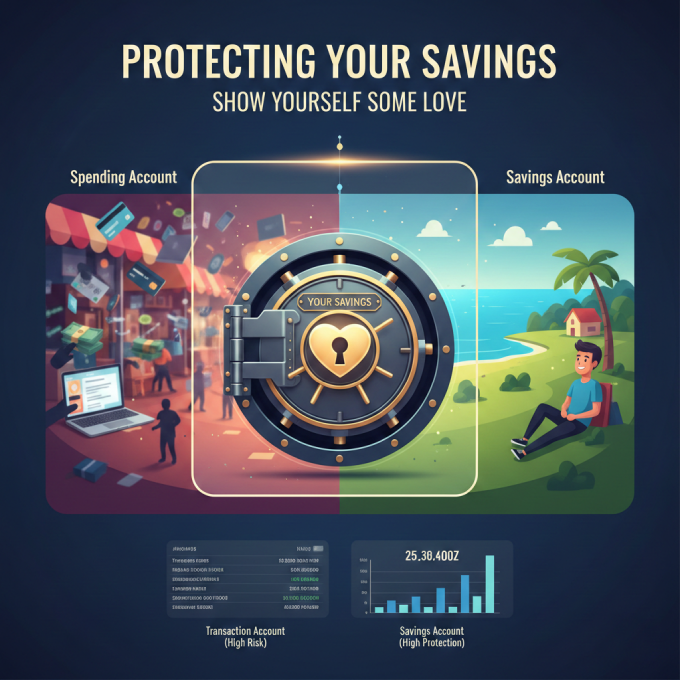
Show Yourself Some Love by Protecting Your Savings
Think of your savings account as a vault safeguarding your future. It holds money for emergencies, retirement or that dream vacation. It’s your financial peace of mind, always there for you and life’s unexpected storms.
Just like you, it deserves care, attention and protection. By keeping your savings separate from your everyday spending, you ensure your money and your heart stay safe, even when life throws surprises your way.
When there are no distinctions between your savings and your everyday funds, your money becomes easier to access, not just for you, but for others wanting what’s yours.
That’s why one of the smartest financial security moves you can make is to keep your savings separate from your expense account and load money into that account when you need to spend. Link your debit card to this account only and send those chasing you for your money the right signal.
Security Benefit #1: Fraudsters Can’t Drain Everything
Your transaction account is exposed daily and is usually linked to where your money moves fastest including:
- Debit card swipes
- Online shopping
- Payment apps
- Subscription services
- Bill payment systems
- Third-party budgeting tools
- Mobile wallet connections
Each of the above is an access point and every access point is an opportunity for fraud, error or compromise.
If a scammer gets your debit card information, a payment app is breached or your login credentials are stolen through phishing, the criminals will go straight for the account that’s easiest to reach, which in this case is the one linked to your card.
But when you have your savings separate, it creates a buffer zone. This means even if someone gets into your transaction account, they can’t instantly wipe out your savings and your future stays protected.
Security Benefit #2: You Have “Control” Over Automated Payments
Ever had a “free trial” quietly roll into a paid subscription, draining your account without warning? Or forgot to cancel a subscription you only wanted for one month or year, not realising until funds are taken from your account for renewal without warning?
Well subscriptions, autopayments, and renewals only operate one way. They pull money when they’re scheduled to pull it. They do not check whether you meant to keep that money untouched. They do not pause because your priorities changed or stop because a charge is incorrect.
When your money isn’t separated, you have no control over what happens. A separate savings account for transactions adds friction and forces an intentional step before money leaves as you should only be putting money on that card-linked account just when you’ll use it. That pause can stop unexpected charges from tapping into funds you weren’t prepared to spend.
Security Benefit #3: You’re Saved from Your Own Impulses
When you use a single account for both saving and spending, the boundary between what’s reserved for the future and what’s available for daily expenses disappears. Your savings will not feel like protected money, but like extra cash that’s just there, ready to be used.
Small, incremental withdrawals may feel harmless but can over time lead to a major financial crisis.
There’s no friction, no pause, and no deliberate decision required; money feels instantly available, and impulses take over.
Separating savings not only introduces a critical pause but also allows for distinct dashboards when logged into online banking platforms, which can help keep your savings out of sight and out of mind. This visual separation reinforces intentional decision-making, curbs impulse withdrawals and preserves your long-term financial security.
The Best Setup: A Two-Tier Structure Built for Security
- Tier One: Transaction Account (High Activity / Higher Risk)
This is your operational account. Load it as necessary to use for:
- Debit card purchases
- Bill payments, subscriptions and payment apps
- ATM withdrawals
- Transfers
This account will always carry higher exposure because it is constantly in motion. The goal is not to eliminate risk here, but to limit what can be lost.
- Tier Two: Savings Account (Low Activity / High Protection)
This is your reserve account. Use it for:
- Emergency funds
- Major financial goals
- Long-term stability
How to Keep Your Expense Account Protected
Even though your transaction account is more exposed to the elements, you can keep it secure with the right safeguards.
- Sign up for banking alerts and receive notifications for withdrawals, transfers and logins to catch unusual activity in real time.
- Enable two-factor authentication (2FA) to add an extra layer of security to your account logins.
- Use strong, unique passwords. Avoid reused or simple passwords that can be easily guessed.
- Regularly monitor account activity and review statements and transactions to spot errors or unauthorised charges early.
- Track ATM and POS usage. Keep an eye on withdrawals and card transactions to quickly identify suspicious activity and use only trusted machines or merchants to reduce the risk of skimming or fraud.
- Shop only on safe, trusted websites. Ensure websites use HTTPS, verify merchant legitimacy and avoid storing card details on untrusted platforms.

Check out more stories like this

Leadership Transition at JN Bank
A Statement from Hon. Earl Jarrett, OJ Deputy Chairman and...
JN Supporting MSME Recovery from Melissa
Micro and small businesses devasted by Hurricane Melissa are set...

Renting a Property? Five Reasons to Get a Signed Rental Agreement
You found a nice home in a great location, and...